
P2 · Mechanics
Mechanics
Speed is a skill. It gets taught in positions, cued in real time and rebuilt until the pattern survives full effort.
Coached Patterns
Cues, common faults, drills.
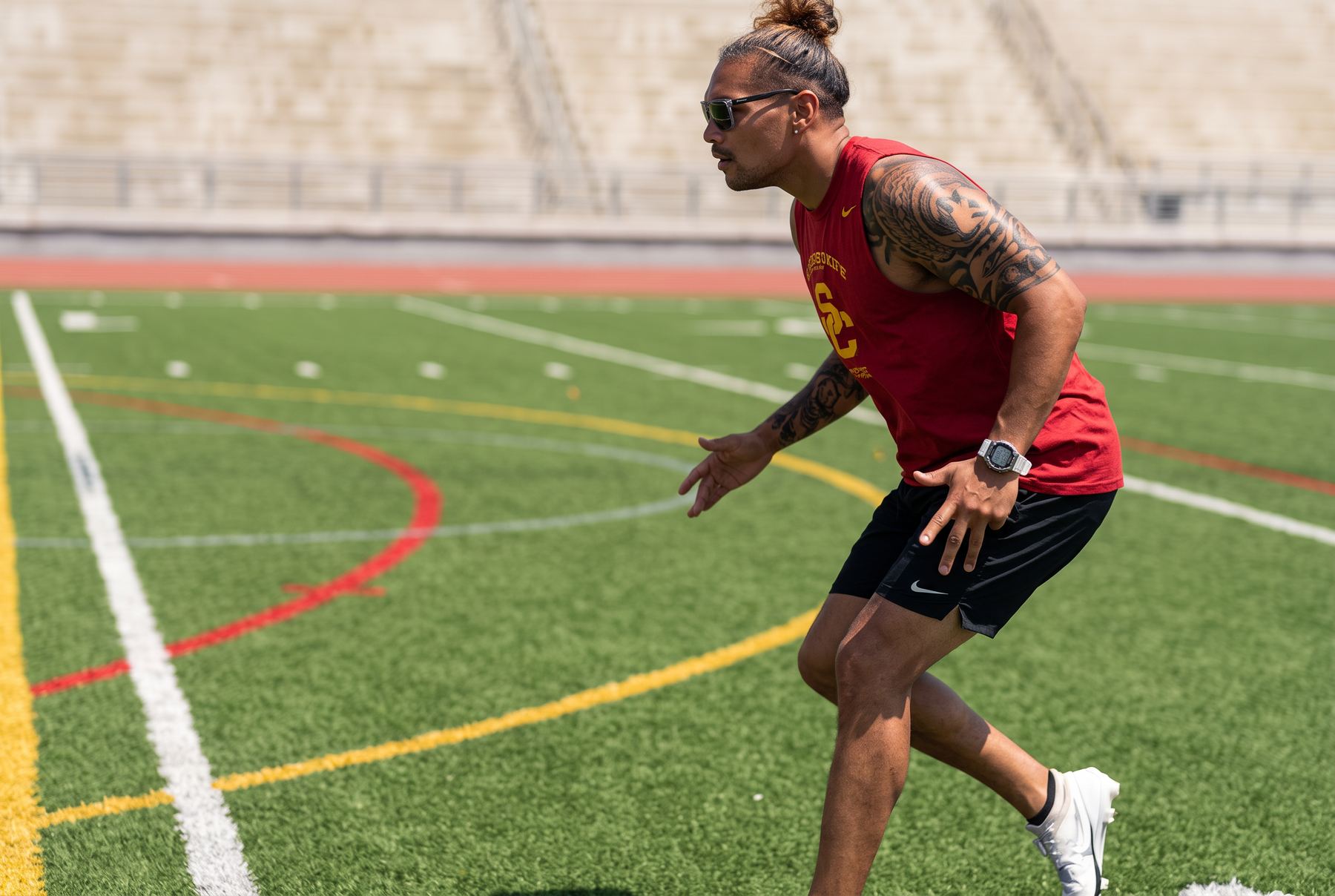
Mechanics work is the difference between an athlete who is strong and an athlete who is fast. Every session starts with a demonstration, moves to a slow rehearsal, then adds speed only when the shape holds. If the shape breaks, the rep count stops.
Sprint Start & Acceleration
Cues
- Front-side shin angle matches the torso — push the ground back, don't reach forward.
- First three steps are piston steps: down and back, no over-striding.
- Arms drive hip to cheek; hands stay relaxed.
Common Faults
Popping upright on step one, heel recovery too high early, arms crossing the midline.
Drills
Wall drills, half-kneeling starts, resisted marches, 10-yard fly-in accelerations.
Top-End Sprinting
Cues
- Tall posture, ribs stacked over pelvis.
- Front-side mechanics: knee up, toe up, strike under the hip.
- Ground contact is short and violent, not long and pushy.
Common Faults
Backside mechanics (heel kicking up behind), reaching with the lower leg, hips sitting under.
Drills
A-skips, straight-leg bounds, dribble series, 20-40 yard flying runs.
Deceleration & Change Of Direction
Cues
- Lower the center of mass before the plant, not during it.
- Plant foot outside the knee line; keep the shin over the toes.
- Eyes and hips lead the exit — the foot follows.
Common Faults
Braking with a straight leg, knee collapsing inward, taking extra steps to turn.
Drills
Two-step decel to hold, drop-step redirects, 5-10-5 mechanics, mirror drills.
Jumping & Landing
Cues
- Load the hips, not the knees.
- Arms fire in sync with the hips on takeoff.
- Land quiet, land with the same hip and knee shape you took off with.
Common Faults
Noisy landings, knee valgus on contact, double-dipping before takeoff.
Drills
Box drops to stick, single-leg hop and hold, hurdle hops, depth jumps for advanced athletes.
Footwork & First Move
Cues
- Feet under the hips, weight in the mid-foot, not on the heels.
- One decisive step beats two hesitant ones.
- React to a cue, not a count — game speed means unplanned.
Common Faults
False stepping, bouncing in place, staring at the feet instead of the read.
Drills
Ladder patterns for coordination, cone reaction series, ball-drop starts, partner mirror work.
Throwing Mechanics (Quarterback)
Cues
- Front hip and lead shoulder point where the ball goes.
- Weight transfers from back hip to front hip before the arm moves.
- Same release point under pressure as on air.
Common Faults
Throwing off the back foot, over-striding, all-arm delivery with no hip sequence.
Drills
Kneeling throws, hitch-and-throw footwork, drive-step ladders, pocket movement to target.
Assessment
What gets measured before anything gets changed.
Movement Screen
Squat, hinge, single-leg stance, overhead position and ankle range scored left versus right.
Sprint Film
10-40 yard runs filmed from the side and behind, reviewed frame by frame with the athlete.
Jump & Land Testing
Vertical, broad and single-leg hop distances with symmetry and landing quality noted.
Change Of Direction
5-10-5 and L-drill timed, then re-run on film to grade plant mechanics, not just the clock.
It's just quiet. It does its thing. Smooth, methodical.
Demonstrate it. Then coach the rep.